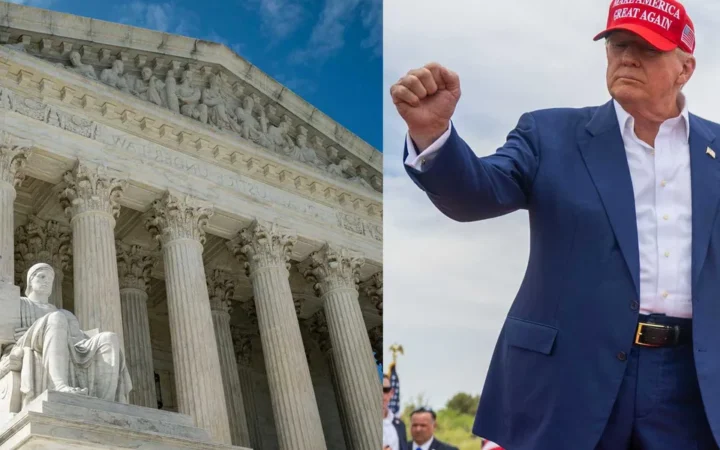
When President Trump was not able to get Congress to repeal and replace not too long ago, he crafted a time bomb that was designed to destroy the Affordable Care Act.
And on Friday it worked when a Texas judge ruled the law unconstitutional.
Obamacare was struck down by a Texas federal judge in a ruling that casts uncertainty on insurance coverage for millions of U.S. residents.
The decision Friday finding the Affordable Care Act unconstitutional comes just before the end of a six-week open enrollment period for the program in 2019 and underscores a divide between Republicans who have long sought to invalidate the law and Democrats who fought to keep it in place.
U.S. District Judge Reed O’Connor in Fort Worth agreed with a coalition of Republican states led by Texas that he had to eviscerate the Affordable Care Act, the signature health-care overhaul by President Barack Obama, after Congress last year zeroed out a key provision — the tax penalty for not complying with the requirement to buy insurance. The decision is almost certain to be appealed all the way to the Supreme Court.
“Today’s ruling is an assault on 133 million Americans with preexisting conditions, on the 20 million Americans who rely on the ACA’s consumer protections for health care, and on America’s faithful progress toward affordable health care for all Americans,” California Attorney General Xavier Becerra said in a statement. A spokeswoman for Becerra said an appeal will be filed before Jan. 1.
Texas and an alliance of 19 states argued to the judge that they’ve been harmed by an increase in the number of people on state-supported insurance rolls. They claimed that when Congress repealed the tax penalty last year, it eliminated the U.S. Supreme Court’s rationale for finding the ACA constitutional in 2012.
The Texas judge agreed.
“The remainder of the ACA is non-severable from the individual mandate, meaning that the Act must be invalidated in whole,” O’Connor wrote.
Now it is unlikely the Supreme Court will save it, Law & Crime reported.
Enter President Trump, whose promise to repeal the ACA was a major campaign talking point. And in a neat coincidence, it seems that he is also relying on tax law to do so. Last December, Trump signed the Tax Cuts and Jobs Act of 2017 (TCJA) into law. One provision of the TCJA eliminated the very penalty that had saved the ACA’s individual mandate. Reducing that mandatory payment to zero was the only action the TCJA took that affected the ACA – but that action has now struck at the heart of Obamacare.
The lawsuit pits states against each another –Plaintiffs include the States of Alabama, Arizona, Arkansas, Florida, Georgia, Indiana, Kansas, Louisiana, Mississippi, Missouri, Nebraska, North Dakota, South Carolina, South Dakota, Tennessee, Texas, Utah, West Virginia, Wisconsin, and Maine, while Defendants are the United States of America, the Department of Health and Human Services, and the Internal Revenue, joined as “intervenors” by California, Connecticut, Delaware, Hawaii, Illinois, Kentucky, Massachusetts, Minnesota, New Jersey, New York, North Carolina, Oregon, Rhode Island, Vermont, Virginia, and Washington, and the District of Columbia. U.S. District Court Judge Reed O’Connor faced the question of whether to uphold the individual mandate now that the “tax” has been effectively eliminated:
No money, no tax. No tax, no Tax Power. No Tax Power, no ACA. Judge O’Connor, pointing out that at its heart, the ACA requires individuals to buy something, dismissed defense arguments to the contrary as “logical gymnastics.”
The real blow to the ACA came in the form of a severability analysis. Judge O’Connor not only struck down the controversial individual mandate, but the entire ACA. O’Connor found that the individual mandate was such a central component of the ACA as to be inseparable from the remainder of the law; as a result, provisions such as those that help Medicare beneficiaries, and those that allow young adults to remain on their parents’ insurance policies will similarly be eradicated (or at least would have been eradicated had a stay not been issued to hold the matter in abeyance until appeals are completed.)