Beginner’s luck. It’s an idea that’s been around for generations. Beginner’s luck is more than just luck – it’s the idea that there’s actually some sort of tangible advantage to being a rookie that you won because you were a beginner.
These explanations make sense. The only problem is that we couldn’t find any references to back them up. And the more we thought about it, we started to wonder, is this phenomenon called beginner’s luck even real, or is it all in our heads?
Well, no, because for this 3-year-old boy who had real beginner’s luck after finding out an unearthed gold pendant that was estimated to be worth over $4 million dollars, and it was found by using a metal detector for the first time!
Everyone has a childhood fantasy of discovering treasure. All of us have watched movies where a mismatched bunch of pals discovers hidden treasure. But one young boy made that wish come true.
One afternoon, little James Hyatt’s dream came true when his father brought him metal detecting for the first time that was owned by his granddad who had been searching for 15 years.
The father and son were out hunting treasure, using their metal detector–when the duo struck literal gold and made an incredibly historical find.
James had occasionally joined his father on his hunts, but this was one of the first times. The metal detector James was using began to beep, suggesting that there was metal beneath the area it was pointed at.
He had only been scanning the soil for a matter of minutes when it started beeping.
Jason Hyatt, who is the father of the little boy said, “James got a buzz after just five minutes, we saw a glint eight inches down and gently pulled the object out. Dad was blown away. He’d never found anything like it in 15 years doing his hobby. James was so excited to find treasure, though he’s too young to realize its significance.”
Little James recalled the event saying, “It went beep beep beep.”
His father began to dig. After about 6 to 8 inches of digging, he literally struck gold.
“We dug six to eight inches down and lo and behold, we got a flash of gold. I moved the earth around and brought it to the surface and there it was,”said Jason Hyatt.
“Then we dug into the mud. There was gold there. We didn’t have a map – only pirates have treasure maps,” 3-year-old James explained to the media.
The 500-year-old gold pendant depicting Saint Helena was discovered by James Hyatt
The names of the Magi and depictions of Christ and Saint Helena are exquisitely carved on a 500-year-old gold reliquary that James found. It may have originally held a piece of the cross, and it would have once been magnificently colored with enamel work filling in the inscriptions and embellishments. It most likely fell from the neck of a wealthy and reverent individual and was lost in the field for 500 years,according to The Guardian.
The 73% gold pendant, which is assumed to be a reliquary, was discovered. A reliquary is a vessel that holds sacred artifacts connected to religious leaders or items with which they are affiliated.
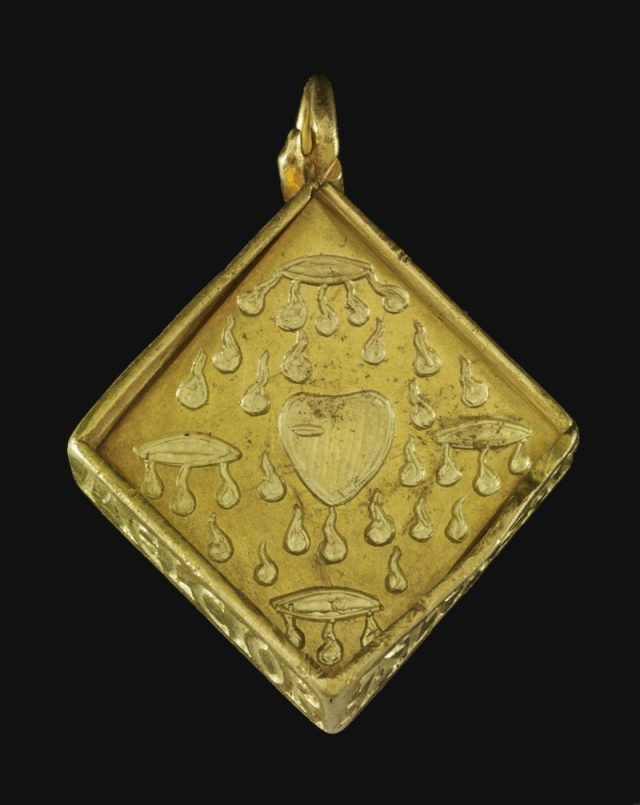
The backside of the 500-year-old gold pendant found by James Hyatt
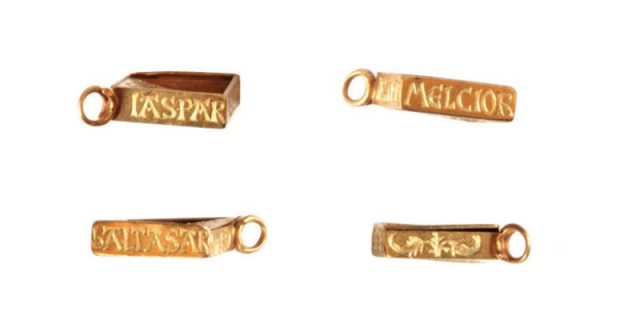
The Three Wise Men’s names are among the several inscriptions on the diamond-shaped pendant. The sides of the pendant are etched with “Iaspar, Melcior, Baltasar.”
The backs of the pendants include four sobbing symbols with eyes and an incision. The five holy wounds that Jesus Christ suffered are supposed to be represented by these inscriptions. Experts believe the locket dates to the reign of Henry VIII and may have belonged to a royal.
The four sides of the gold pendant
The report said despite the pendant’s estimated value of $4 million, the family received only £70,000 for their discovery. And were to be split equally between the Hyatts and the landowner, the funds were provided by the Art Fund charity and the Friends of the Museum.
Marilyn Hockey was in charge of the relic’s conservation two years after it was discovered in 2010. The contents of the necklace were visible when the back panel slid open. Flax fibers were found inside, which experts believe were cultivated locally at some point. It is unknown if these flax fibers have any significance or were inserted on purpose.
The discovery was deemed a treasure at the coroner’s inquest, and since 2012 it has been permanently displayed in the medieval gallery of the British Museum.