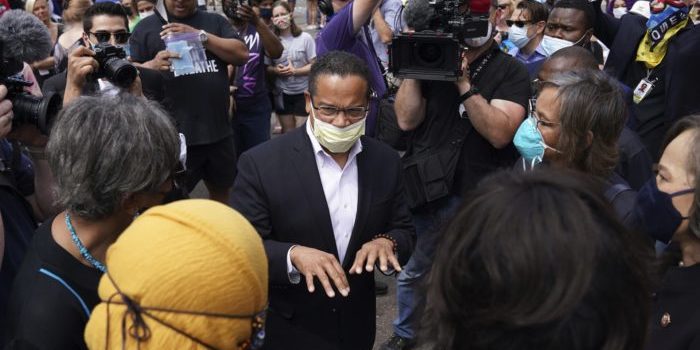
Minnesota Attorney General Keith Ellison has filed a federal lawsuit seeking to compel Texas Gov. Greg Abbott to authorize the extradition of an Immigration and Customs Enforcement agent accused of shooting a man and then providing false information about the incident.
Christian Castro, 52, has remained in a Cameron County, Texas, jail since his arrest May 29 on a nationwide warrant issued in Minnesota.
Hennepin County prosecutors charged Castro on May 18 with four felony counts of second-degree assault with a dangerous weapon and one misdemeanor count of falsely reporting a crime. The charges arise from a Jan. 14 ICE operation in Minneapolis.
According to the criminal complaint, Castro was attempting to apprehend another man when several people entered an occupied home. Prosecutors allege Castro fired his weapon through the front door despite knowing people were inside.
The bullet struck Julio Cesar Sosa-Celis in the leg before continuing into a wall in a child’s bedroom. Sosa-Celis survived the shooting.
Castro allegedly told authorities that he and other federal agents had been attacked with a snow shovel and broom handle. Minnesota investigators contend that video evidence and other information contradicted parts of that account.
The allegations have not been proven in court, and Castro is presumed innocent unless convicted.
Minnesota Gov. Tim Walz signed a formal extradition request on June 2 and forwarded it to Abbott. Ellison’s office says the Texas governor has neither signed the required rendition warrant nor provided a legally sufficient reason for withholding it.
Ellison sent Abbott a letter on Aug. 13 warning that Minnesota would take legal action unless the request was honored. The lawsuit followed on Aug. 18.
“Christian Castro will stand trial in Minnesota,” Ellison said while announcing the case.
Minnesota argues that Abbott’s inaction violates the Extradition Clause of the U.S. Constitution, federal law and Texas’ own extradition statute. Interstate extraditions are generally treated as mandatory when the requesting state submits valid documentation showing that a person is charged with a crime.
Abbott’s office has declined to discuss the pending extradition matter publicly.
The approaching detention deadline has added urgency to the dispute. Texas law generally limits how long an alleged fugitive can remain incarcerated without a governor’s warrant. Castro’s 90-day detention period is expected to expire Aug. 27.
Minnesota officials warn that he could be released if Abbott does not act. They have also argued that Castro presents a flight risk because of his reported connections to Mexico.
The federal complaint seeks an order requiring Abbott to approve Castro’s transfer and preventing Cameron County authorities from releasing him while the case is litigated.
A federal judge has accelerated consideration of Minnesota’s emergency request. The parties were directed to submit written arguments before an in-person hearing scheduled in Brownsville ahead of the deadline.
The prosecution has also intensified political tensions surrounding federal immigration enforcement. The Department of Homeland Security has characterized the charges against Castro as politically motivated, while Minnesota officials maintain that federal employment does not shield an agent from prosecution under state law.
The lawsuit does not ask the federal court to determine whether Castro committed the alleged assault. Its immediate purpose is to decide whether Texas must surrender him so those accusations can be heard in a Minnesota courtroom.
Ellison’s position is straightforward: The underlying case belongs before a jury, not in a political standoff between two governors.